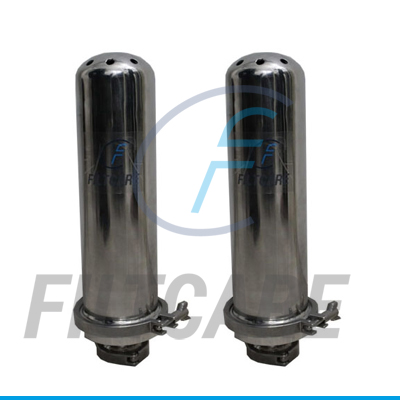
Self Cleaning Filter
Self Cleaning Filters assure continuous flow, trouble-free operation and simplified maintenance. Scrapper Mechanism Self Cleaning is used for preliminary filtration following the same principle of differential pressure. It is easy to clean element just by rotating knob or outside shaft handle manually or by a geared motor. The contaminant from the element surface are by a Brush or Scraper Blade and collected at the bottom can be drained out easily.
Self cleaning filter working principle
The medium to be cleaned is guided into the filter by inlet, which passes from inside to outside through the element gap. After filtration, the filtered fluid enters the filter housing from the to. The bigger solids are separated on the inner surfase or filter element. When it runs for a certain time, the gap between wires element gets plugged up by impurities and meanwhile the differential pressure reaches its pre-set value. Then PLC inspects the signal and sends out the indication to gear motor. The gear motor drives the scraper and the particles or agglomerates are skimmed from the surface, thereby keeping the function of elements well and keeping the element gap clean.
When the impurities at the bottom of the filter increases, the drain valve opens up and the impurities are emptied successfully, which makes the system pressure achieve normality. Because of well-set position and optimum scraping angle, the a rotational scraper drains off the impurities from the filter with the help of the gear motor. This avoids the burden of taking apart the element and washing it, which results into successful filtration of the medium. The scraper system contains Agitator, Mechanical Seal and Control Panel, which are designed for automatic cleaning, and especially for the reasonable spring pressure, maximally reducing the element's abrasion.
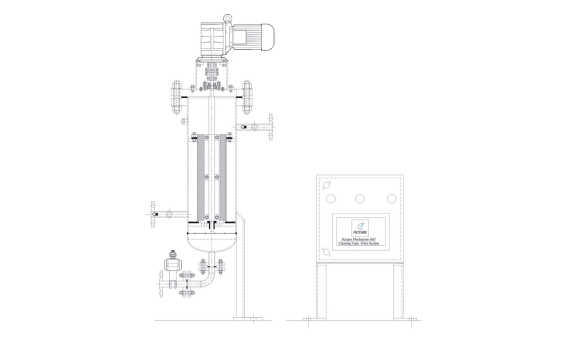
The medium to be cleaned is guided into the filter by inlet, which passes from inside to outside through the cartridge gap. After filtration, the filtered fluid exits the filter housing from the top, opposite to the inlet connection and the bigger solids are separated on the surface of the triangular cartridge wires. When it runs for a certain time, the cartridge gap gets plugged up by impurities and meanwhile the differential pressure reaches its pre-set value. Then PLC inspects the signal and sends out the indication. The gear motor drives the scraper and the particles or agglomerates are skimmed from the surface, thereby keeping the function of cartridge well and keeping the cartridge gap clean.
When the impurities at the bottom of the filter increases, the drain valve opens up and the impurities are emptied successfully, which makes the system pressure achieve normality. Because of well-set position and optimum scraping angle, the rotational scraper drains off the impurities from the filter with the help of the gear motor. This avoids the burden of taking apart the cartridge and washing it, which results into successful filtration of the medium. The scraper system contains stator, PTFE scraper and spring, which are designed for automatic cleaning, and especially for the reasonable spring pressure, maximally reducing the cartridge's abrasion.

SingleBag Filter system suitable for
- Compact Design and Low in weight
- Low pressure drop across the filter
- Adequate strength of element and housing
- Filter element with very high mechanical strength
- Low Maintenance Cost
- Component or parts suitable for and compatible with hydraulic fluid concerned.
- Allow to interchange same type of component with another
- Filtration down to 40 microns
- Highly affordable, long-lasting equipment, with low operation costs
Technical Specifications
- Filtration Rating: Down to 40 microns
- Filter Element: High-strength materials (wire/cartridge type)
- Cleaning Mechanism: Rotational scraper driven by gear motor
- Control System: PLC-based automated control
- Compatibility: Suitable for hydraulic fluids
- Operating Pressure: Industry-standard range (customizable)
- Design: Compact, lightweight, corrosion-resistant
- Maintenance Requirement: Minimal with easy part interchangeability
Key Benefits
- Automatic Cleaning: PLC-controlled scraping ensures continuous filtration with no need to stop the process for manual cleaning.
- Reduced Pressure Drop: Maintains steady fluid flow, saving energy and protecting system components.
- Robust Construction: High mechanical strength of elements and housing suited for harsh industrial applications.
- Cost-Efficient Maintenance: Interchangeable parts mean quick replacement, minimizing downtime and cost.
- Versatile Applications: Compatible with a wide range of hydraulic and industrial fluids.
- Petrochemical Plants
- Chemical Plants
- Power Plants
- Pulp industries
- Nuclear Plants
- Process Water
- Paper Plants
- Steel Plants
- Mines
- Effluent treatment
- Cooling Towers
- Paints and pigments
- Irrigation
- Water treatment
Our Self Cleaning Filters are optimally designed for challenging industrial environments, including:

Frequently Asked Questions (FAQ) for Self Cleaning Filters
What is a Self Cleaning Filter and how does it work?
A Self Cleaning Filter uses a scrapper mechanism to clean the filter element by automatically removing contaminants through a brush or scraper blade driven by a geared motor. This ensures continuous flow and simplified maintenance without the need for disassembly. The fluid passes through the filter element where solids are trapped, and once differential pressure reaches a preset limit, the scraper removes impurities to maintain filtration efficiency.
What industries can benefit from using Self Cleaning Filters?
Self Cleaning Filters are widely used in petrochemical, chemical, power plants, pulp, nuclear, paper, steel, mining, effluent treatment, cooling towers, paints and pigments, irrigation, and water treatment plants. They are ideal for applications requiring reliable filtration down to 40 microns with low operational costs.
What are the main advantages of these Self Cleaning Filters?
Key advantages include a compact and lightweight design, low pressure drop across the filter, high mechanical strength of elements, compatibility with hydraulic fluids, easy interchangeability of components, and filtration efficiency down to 40 microns. These factors contribute to low maintenance and operational costs.
How is the cleaning process automated in these filters?
The cleaning is automated using a PLC-controlled system that monitors differential pressure. When the pressure reaches a preset threshold, it activates the gear motor to drive the scraper which removes accumulated particles from the filter surface. The impurities are then drained via a valve, restoring normal system pressure without manual intervention.
Can the filter components be interchanged or replaced easily?
Yes, the filter system is designed to allow easy interchangeability of components, simplifying maintenance and reducing downtime. The components are highly durable and compatible with various hydraulic fluids to ensure a long service life.
What sizes of contaminants can be filtered by this system?
The filters can effectively remove particles down to 40 microns, making them suitable for filtering out most solid contaminants in industrial fluids.
Is the Self Cleaning Filter suitable for use in hydraulic systems?
Absolutely. The filters’ components are compatible with hydraulic fluids, making them well-suited for hydraulic and lubrication systems that require clean fluids to extend equipment life.
Which regions and countries do you supply these Self Cleaning Filters to?
We supply Self Cleaning Filters across major Indian states such as Maharashtra, Gujarat, Rajasthan, Karnataka, Andhra Pradesh, Uttar Pradesh, Haryana, Telangana, and Madhya Pradesh. Internationally, we serve UAE, Bahrain, Iran, Iraq, Oman, Saudi Arabia, Qatar, Indonesia, Africa, Brunei, Israel, and Kenya.